In short
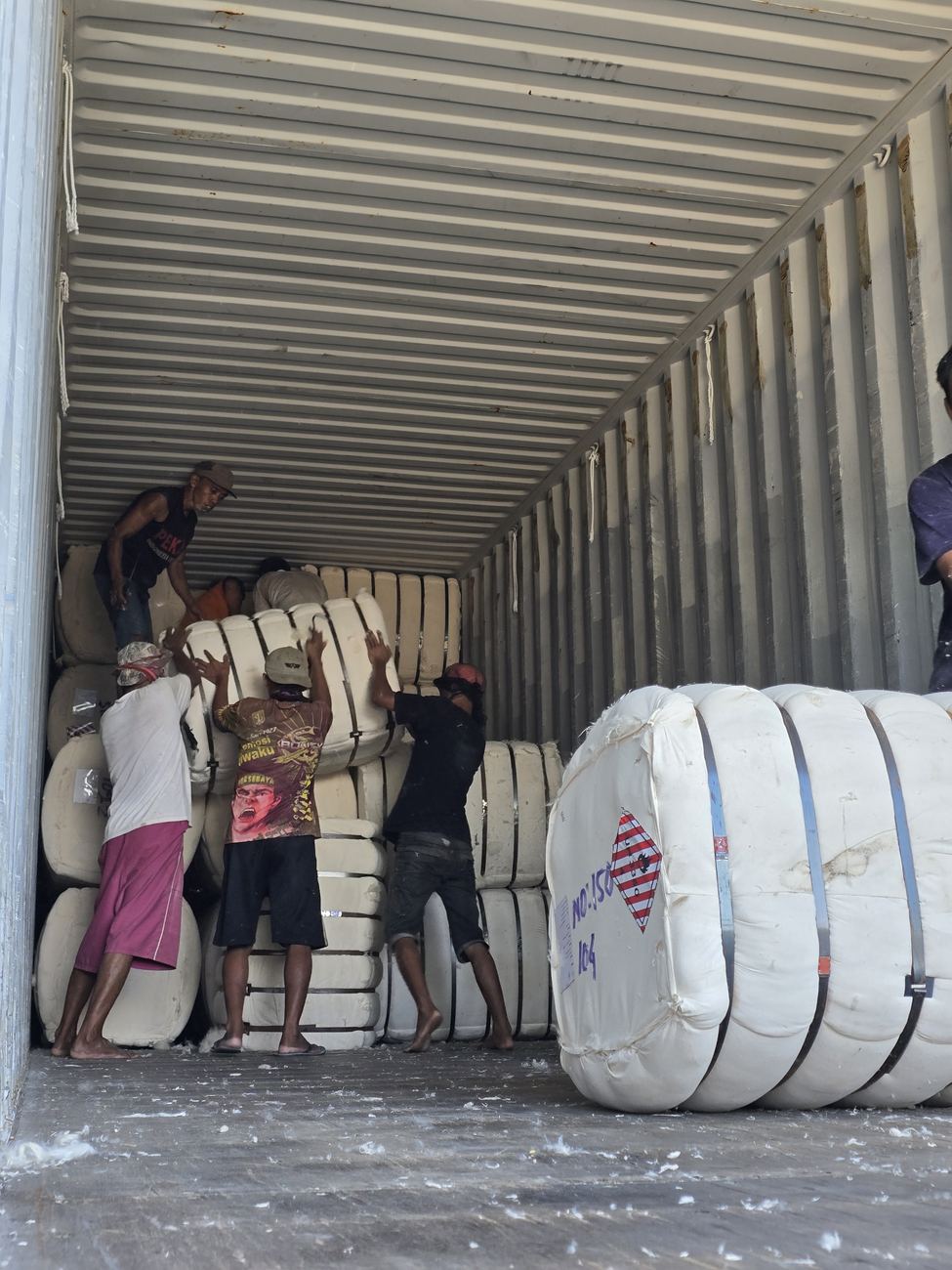
Kapok ships in pressed bales inside containers. Your minimum order depends on bale size — from one 20FT for 100 kg bales. It's a declared flammable solid (UN 3360, IMO Class 4.1), so you'll need a Safety Data Sheet and DG documentation. Bigger bales carry more fiber per container and cut your freight per kilo.
Importing kapok isn't complicated, but it does have a few quirks — mainly around bale sizes and its dangerous-goods classification. Here's the full picture, in the order you'll actually need it.
1. Decide your bale size first
Bale size drives everything else: how much fiber fits in a container, how much you pay in freight per kilo, and how easy the bales are to handle at your end. Kapok is typically supplied in these formats:
- 25 kg bales (PP wrap) — easiest to handle by hand; about 7,500 kg per 40HC.
- 50 kg bales (PP wrap) — a middle ground; about 12,500 kg per 40HC.
- 100 kg bales (cotton or PP wrap) — pressed hardest; about 18,000 kg per 40HC.
The bigger the bale, the harder it's pressed — so a container of 100 kg bales holds far more fiber than the same container of 25 kg bales.
2. Understand the MOQ
Minimum order quantity is tied to bale size. For 100 kg bales, you can start from a single 20FT container. Smaller bales are usually supplied from one 40HC. If you need a trial quantity or a mixed grade ratio, ask — many suppliers (us included) will work with you on a first order.
3. Choose your incoterms
Most kapok trades FOB (you arrange freight from the load port — commonly Surabaya for East Java shippers) or CIF (the supplier arranges freight and insurance to your port). FOB gives you control of shipping; CIF is simpler if you'd rather the supplier handle the logistics.
4. Know the dangerous-goods class
This is the one that surprises first-time buyers: kapok can spontaneously combust if wet or poorly stored, so it's classified as a flammable solid — UN 3360, IMO Class 4.1, Packing Group III. That's routine and manageable, but it must be declared correctly. A reputable supplier ships it as properly declared dangerous goods and provides the paperwork.
5. Line up your documents
For a smooth import, expect to handle:
- Commercial invoice & packing list
- Bill of Lading
- Safety Data Sheet (SDS) — required for the DG class
- Certificate of Analysis (COA) for the batch — moisture, composition, etc.
- Certificate of Origin (and any fumigation/phytosanitary certificate your country requires)
6. Vet your supplier
Ask to see the actual operation — a real warehouse, real bales, real loading photos — not just a stock catalogue. Ask for the SDS and a sample COA up front. And confirm they've exported to your region before. Then spec your grade →